
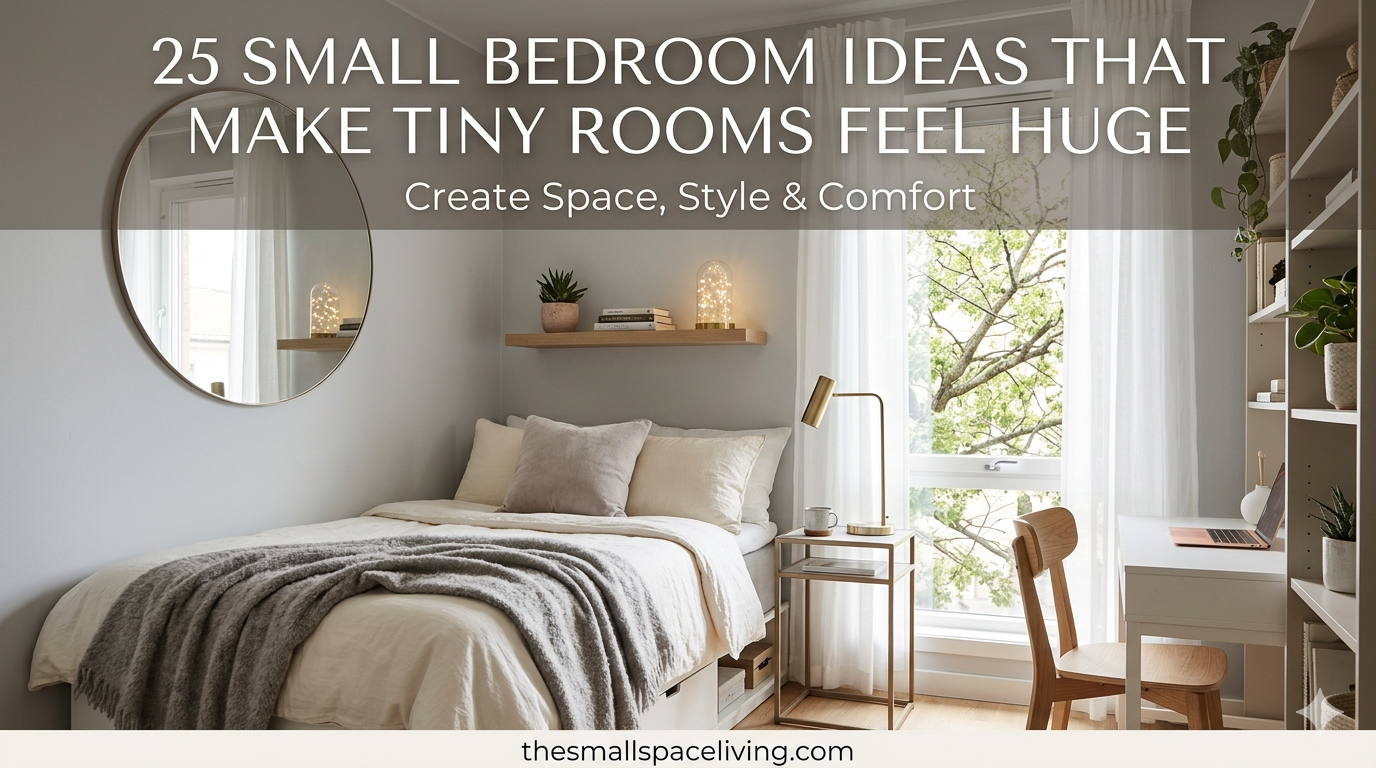
Let me be honest with you — I have lived in a bedroom the size of a large closet. I’m talking barely enough space to open the door without hitting the bed. And you know what? It taught me everything I know about making small rooms feel surprisingly luxurious.
Whether you’re in a city apartment, a starter home, or a guest room that somehow became your permanent room, this guide is packed with real, actionable ideas — not the “just buy an expensive designer sofa” kind. These are tricks that actually work, backed by interior design principles, spatial psychology, and a little hard-won experience.
Let’s get into it — 25 ideas, starting with the game-changers.
💡 The Classics
1 Go Big on Mirrors
If there’s one trick every interior designer swears by, it’s mirrors. A large mirror — or a well-placed gallery of smaller ones — visually doubles the perceived depth of a room. It bounces light around, creates a second “view,” and tricks your eye into thinking there’s more square footage than there actually is.
The sweet spot? A floor-to-ceiling mirror on one wall, or a large leaner mirror angled slightly outward near a window. Avoid placing mirrors directly opposite each other — that creates an endless tunnel effect that can feel disorienting.
Pro Tip
Position your mirror to reflect a window or light source, not a blank wall. Light reflected doubles the brightness — and brightness reads as space.
2 Invest in a Murphy Bed (Wall Bed)
This is the single most dramatic transformation you can make in a tiny bedroom. A Murphy bed folds up into the wall during the day, instantly reclaiming 50–60 square feet of floor space. Modern versions come with integrated shelving, a desk that folds down with the bed, or even a couch that converts.
The stigma of “those fold-down dorm beds” is long gone. Today’s Murphy beds from brands like Resource Furniture and IKEA look stunning and sleep just as comfortably as a regular bed.
3 Paint the Walls a Light, Warm Neutral
Color science is real. Light colors — soft whites, warm creams, pale greiges, and muted sage greens — reflect more light and make walls feel farther away. Dark colors do the opposite: they absorb light and bring walls closer visually.
That said, don’t default to cold white. Warm whites (Benjamin Moore’s “White Dove,” Farrow & Ball’s “Pointing”) feel cozy without feeling cold. They make natural light sing.
4 Use Every Inch Under the Bed
The space under your bed is prime real estate that most people completely waste. A standard queen bed has approximately 25 cubic feet of under-bed storage — that’s equivalent to a decent-sized dresser.
Invest in a bed frame with built-in drawers, or use slim rolling storage bins. Vacuum storage bags for seasonal clothing are absolute game-changers — they compress bulky items down to almost nothing.
5 Think Vertical — Floor to Ceiling Shelving
Most people use only the bottom 5 feet of their walls. The space above eye level? Completely ignored. Yet that’s where the magic is in a small room.
Floor-to-ceiling shelving units draw the eye upward, making the ceiling feel higher. They create massive storage without eating into floor space. Style the upper shelves with plants, books, or decorative objects — and keep the lower shelves functional with baskets and boxes.
Pro Tip
Paint the back panel of your shelving unit the same color as your wall. The shelves will “float” and the room will feel larger.
🛋️ Furniture Tricks
Ideas 6–10: Furniture That Works Smarter
Idea 06 Choose Furniture with Legs
Sofas, beds, and nightstands on legs let light pass underneath, making the floor feel larger. Floating furniture has the opposite effect — it visually anchors heavy pieces to the floor.
Idea 07 Lucite & Glass Pieces
A clear acrylic nightstand or glass desk takes zero visual space. Your eye passes right through it, perceiving only the wall behind. Magic trick, no assembly required.
Idea 08 Floating Nightstands
Wall-mounted nightstands free up your floor completely. They’re modern, easy to style, and you can adjust the height to match your exact mattress level.
Idea 09 Loft or Bunk Your Bed
A loft bed elevates sleeping to the upper zone, leaving the entire floor beneath free for a desk, dresser, or lounge area. Brilliant for rooms with high ceilings.
Idea 10 Use a Daybed
A daybed functions as both seating and sleeping — perfect for studio situations or guest rooms that double as a home office or sitting room.
Bonus Ottoman with Storage
At the foot of the bed, a storage ottoman replaces both a bench and a storage chest — two pieces of furniture in one, with no extra footprint.
“A well-designed small room doesn’t feel small — it feels intentional. Every element has purpose, and that purpose creates a sense of calm order that a cluttered large room never achieves.” — Nate Berkus, Interior Designer
💡 Light & Illusion
11 Maximize Natural Light
Natural light is the single most powerful tool for making a small room feel open. Keep windows unobstructed — swap heavy drapes for sheer linen curtains or Roman shades that mount inside the window frame. Consider removing window treatments entirely on windows that don’t face neighbors.
Trim any outdoor plants blocking windows. Even a 20% increase in natural light can dramatically change how large a room feels.
12 Layer Your Lighting
A single overhead light makes a room feel flat and small. Layered lighting — ambient (ceiling), task (bedside), and accent (LED strips, floor lamps) — creates dimension and depth.
Warm-toned LED bulbs (2700K–3000K) make walls recede slightly and create a cozy, expansive feel. Cold white light does the opposite — it makes spaces feel clinical and smaller.
Pro Tip
Uplighting — placing a lamp that throws light toward the ceiling — makes ceilings feel dramatically higher. A single floor lamp tucked in a corner costs under $40 and works wonders.
13 Hang Curtains High and Wide
This is one of the oldest tricks in the interior designer’s playbook — and it still shocks people when they see the before-and-after. Instead of mounting curtains at the window frame, mount them 4–6 inches from the ceiling, and extend the rod 8–12 inches past the window on each side.
The result? Your window looks enormous. The ceiling looks higher. The room looks significantly larger. Total cost: $30 for a longer curtain rod.
| Treatment | Light Level | Privacy | Space Effect | Cost Range |
|---|---|---|---|---|
| Sheer linen curtains | ⭐⭐⭐⭐⭐ | ⭐⭐ | Most spacious | $25–$80 |
| Roller shades (inside mount) | ⭐⭐⭐⭐ | ⭐⭐⭐⭐ | Very clean | $30–$120 |
| Roman shades | ⭐⭐⭐ | ⭐⭐⭐⭐ | Structured look | $50–$200 |
| Blackout curtains | ⭐⭐ | ⭐⭐⭐⭐⭐ | Can feel heavy | $40–$150 |
| Heavy drapes (floor length) | ⭐ | ⭐⭐⭐⭐⭐ | Makes room smaller | $80–$400 |
14 Create a Focal Point
A room without a focal point feels chaotic and small. Choose one wall — usually the wall your bed faces — and make it the star. A bold wallpaper, a large piece of art, or even just a well-styled shelving arrangement gives the eye a place to land, which paradoxically makes the whole room feel more organized and spacious.
15 Add One Large Plant
It sounds counterintuitive — adding something to a small room to make it feel bigger? But a single, tall plant (think fiddle leaf fig, monstera, or bamboo palm) does something remarkable. It adds a vertical element, creates a sense of life and depth, and softens hard lines that make rooms feel boxy.
One large plant beats five small plants. Go big or go home — literally.
🗂️ Organization & Declutter
16 Edit Ruthlessly — Less Really Is More
No design trick in the world compensates for clutter. Every object in a small bedroom takes up visual space — even if it’s small, even if it’s on a shelf. The Japanese concept of ma — the beauty of empty space — applies perfectly here.
Go through your bedroom and remove everything that doesn’t serve either a functional or a deeply intentional aesthetic purpose. Box it up, donate it, or move it to another room. Then live with the empty space for a week before adding anything back. You’ll be shocked how much you don’t need.
17 Use Matching Storage Containers
One of the fastest ways to make a small room look chaotic is mixed, mismatched storage — different boxes, different baskets, different bins all over the shelves. Switching to a single, coordinated storage system (all white boxes, all natural wicker baskets, all matte black canisters) creates instant visual calm.
Calm = spacious. Every time.
18 Mount Your TV on the Wall
A TV on a stand needs a TV stand. A TV mounted on the wall needs nothing on the floor. Wall-mounting your TV removes a bulky piece of furniture entirely and creates a cleaner, more hotel-like visual that reads as spacious and curated.
Run cables through the wall (a $15 cable management kit from any hardware store) for a truly seamless look.
19 Maximize Your Closet Space
A disorganized closet overflows into the bedroom. An organized closet keeps everything neatly contained. Invest in a proper closet system — IKEA’s PAX system, The Container Store’s Elfa, or even a well-planned DIY setup with double hanging rods, shelf dividers, and door organizers.
Doubling your closet’s storage capacity often means you can remove a dresser from the bedroom entirely — reclaiming significant floor space.
- Add a second hanging rod for shirts and folded items
- Use slim velvet hangers (doubles hanging capacity)
- Add door-mounted shoe organizers or racks
- Use shelf dividers to stack sweaters neatly
- Install LED strip lights inside the closet
20 Use a Pegboard or Floating Shelf Above the Desk
If your bedroom doubles as a home office, a pegboard or floating shelf system above the desk keeps your work tools visible, accessible, and completely off the desk surface. A clear desk surface in a small room makes everything feel more open.
🔮 Advanced Designer Moves
21 Use a Continuous Flooring Material
Interrupting your floor with multiple rugs, transitions, or mismatched materials visually chops the room into smaller sections. A single, continuous flooring material — or one large area rug that anchors the entire sleeping zone — makes the floor plane read as one cohesive, larger space.
If you have a rug, go bigger than you think you need. A rug that’s too small is worse than no rug at all — it makes the room feel smaller and the furniture look awkward.
Rule of Thumb
In a bedroom, the rug should extend at least 18–24 inches beyond the sides of the bed. All four legs of bedside tables should sit on the rug.
22 Use Stripes Strategically
Horizontal stripes on the wall make a room feel wider. Vertical stripes make ceilings feel higher. Diagonal stripes (in a rug or textile) add energy and movement without making the room feel smaller.
A simple striped rug running lengthwise in a narrow bedroom can visually add several feet to its perceived length. And you don’t need to commit to stripe wallpaper — even striped bedding creates this effect.
23 Try a Monochromatic Color Scheme
When walls, bedding, curtains, and key furniture are all in the same color family (different shades and textures, but the same hue), the room loses its visual “edges.” Without strong color boundaries, the eye perceives the space as larger and more unified.
An all-ivory room or an all-sage room reads as a much bigger space than one with competing colors. The textures — linen, cotton, wood, ceramic — do the visual work that color would otherwise fragment.
24 Add a Statement Ceiling Moment
Most people never look up in a room. Which is exactly why the ceiling is your secret weapon. A light, beautifully lit ceiling makes the entire room feel taller and grander.
Options include: a wash of warm white paint (especially if your current ceiling is a cold, flat white), a ceiling medallion around your light fixture, string lights along the perimeter, or even a subtle pattern using ceiling-safe removable wallpaper. Your ceiling is 100% usable design space — use it.
25 Embrace a “Less But Better” Philosophy
The final idea isn’t about a product or a paint color — it’s a mindset shift. The German design philosophy of weniger, aber besser (less, but better) is the secret code of every beautiful small room you’ve ever seen.
Instead of filling every surface, choose fewer things — and make each one count. One beautiful lamp instead of three mediocre ones. One large piece of art instead of a cluttered gallery wall. One quality duvet in a color you love, instead of four decorative pillows you’re lukewarm about.
Small rooms force you to make deliberate choices. And deliberate choices, it turns out, create genuinely beautiful rooms — at any size.
Ready to Transform Your Bedroom?
Save this article, bookmark your favourites, and start with just one idea this weekend. Small changes, implemented consistently, create dramatic transformations.
Final Thoughts
I started this article by telling you about my tiny bedroom. That space taught me something I genuinely believe: limitation breeds creativity. When you can’t just add more square footage, you get creative. You think more carefully. You choose better.
The best small bedrooms I’ve ever been in didn’t feel small at all. They felt intentional. Considered. Peaceful. That’s the goal — not to pretend you have more space than you do, but to make the space you have feel exactly right.
Pick your three favorite ideas from this list. Start this weekend. And let us know in the comments which ones made the biggest difference for you.
— Happy decorating. 🏡